Student Visa
UK Student Visa Credibility Interviews 2027: What the 79% Figure Means
Preparing for a UK Student visa credibility interview in 2027? Understand the reported 79% figure, course questions, financial evidence and how HANEEVA helps you prepare.
Your UK Study Plans Deserve More Than a Memorised Interview Answer
A UK university offer can be exciting, particularly for Indian students investing family savings, education loans and years of preparation in an international degree. Yet a university offer, tuition deposit or Confirmation of Acceptance for Studies does not remove the need to meet UK immigration requirements. Some applicants may be invited to a credibility interview so UK Visas and Immigration (UKVI) can assess whether their study intentions are genuine. The strongest approach is to understand your real academic plans and explain them clearly. HANEEVA Overseas Education helps students prepare for this important stage with practical course research, accurate document checks and personalised interview practice. The goal is clarity, consistency and genuine academic readiness.
What Does the Reported 79% Interview Figure Really Mean?
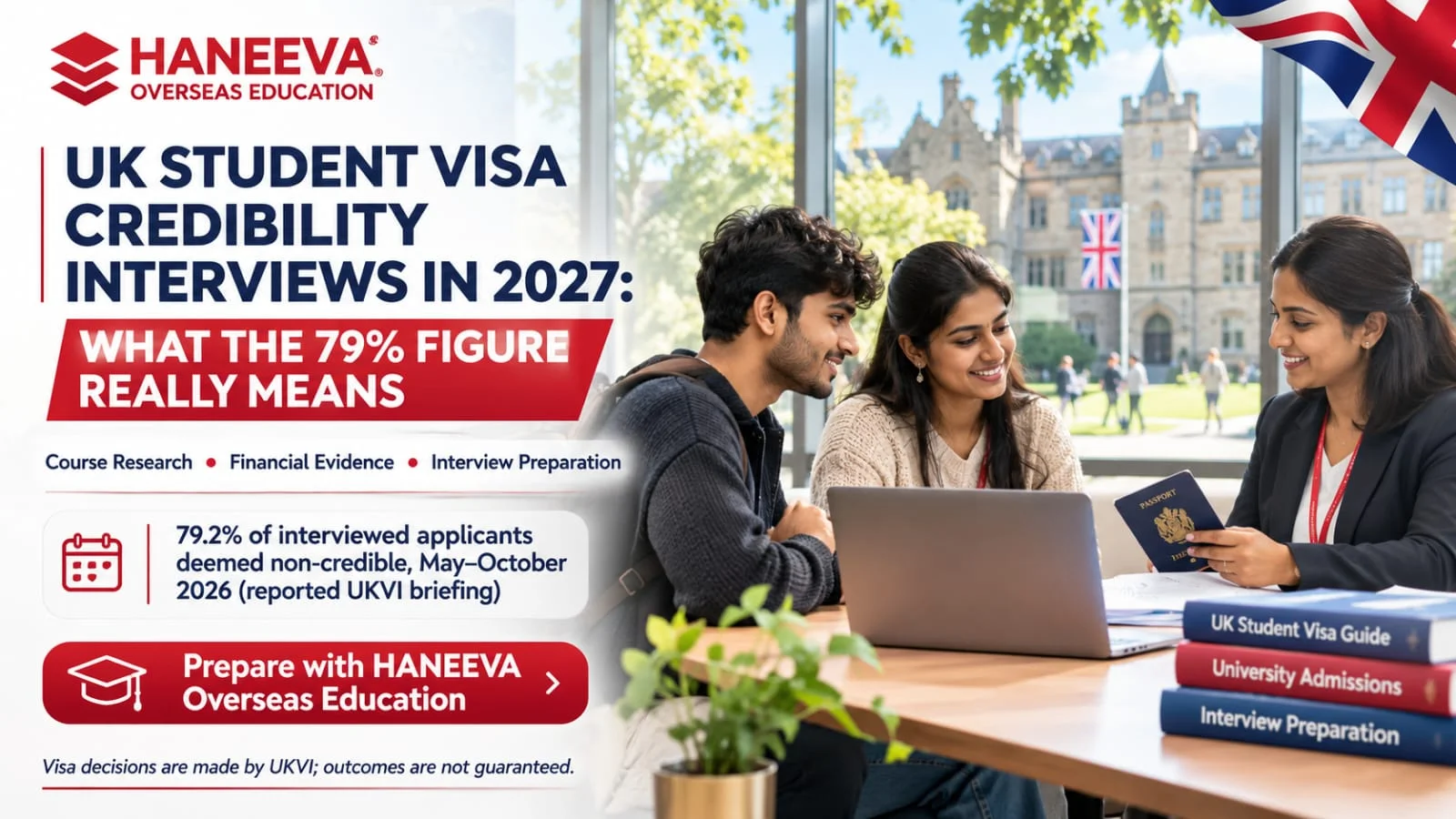
The PIE News reported on 18 November 2026 that 9,043 of 11,415 applicants interviewed between May and October 2026 were assessed as non-credible, citing a UKVI sector briefing it had obtained. That is approximately 79.2% of that interviewed group, not 79% of all Student visa applicants. The briefing itself was not independently available for this article to inspect.
The report covers a selected interview cohort and a six-month period in 2026. It is not an overall annual refusal rate, a forecast for 2027, or your personal probability of refusal. Being invited to an interview does not determine the outcome. Read the figure in context and focus on explaining your genuine plans accurately.
What the UK Government Actually Requires
The Immigration Rules, Appendix Student, say in paragraph ST 5.1 that an applicant must be a genuine student. Current Home Office caseworker guidance explains that officials may consider the application, relevant supporting information and answers given during an interview. If the decision-maker is not satisfied that the applicant is genuine, a refusal may follow under the applicable rules.
An official Home Office announcement of 3 September 2025 described increased use of credibility interviews as part of wider immigration compliance measures. That policy statement is useful context, but its figures about short-term study visas must not be confused with refusal rates for university-level Student visa applicants. The updated Student and Child Student caseworker guidance published in October 2026 sets out the interview and genuine-student assessment process. HANEEVA recommends using these published rules rather than attention-grabbing claims about the likelihood of rejection.
Why Does UKVI Conduct Credibility Interviews?
The interview helps officials explore points not fully explained by paperwork, including the applicant's purpose, course choice, academic progression and funding. Answers are evaluated alongside the rest of the application, rather than against one perfect script.
Caseworkers may consider why the applicant selected the UK, the institution and the specific programme; how earlier education or employment connects with the course; whether the financial plan makes sense; and whether the applicant can communicate sufficiently in English. Home Office guidance identifies reasons for study, academic progression, course knowledge, finances and English communication as relevant credibility considerations. The test is credibility, not the ability to repeat a scripted speech.
Five Areas That Can Make or Break an Interview
1. Know Your University and Exact Programme
Students should know the full course title, campus, qualification, duration, major modules, assessment style and intended intake. Read the official course page rather than relying only on an agency brochure. Be prepared to explain how particular modules address skills you need. For example, a computing applicant might connect cloud security or data engineering modules with prior projects and realistic future responsibilities. Memorising a list of module names is less persuasive than understanding why those subjects matter.
2. Explain Why the UK and Why This University
A genuine choice has an academic explanation. Think about the course structure, available facilities, academic fit, teaching approach and relevant student support. Comparing other programmes can support your own decision-making, but UKVI does not require applicants to compare the UK with other countries. Avoid unsupported claims that foreign universities are always superior. An honest answer may acknowledge an alternative programme while explaining why the selected UK course better fits the applicant's needs, time frame and financial capacity. Students should also understand where their university is located and what living there may involve.
3. Connect Your Degree With a Realistic Career Plan
A good answer describes a direction, not a guaranteed job title or salary. Explain the roles you hope to pursue, the skills employers expect and how your chosen programme contributes to those skills. If you intend to return to India, discuss plausible employers or industries and your professional or family circumstances. If you are considering lawful post-study opportunities, distinguish those possibilities from the main purpose of studying. Neither the Graduate route nor future employment should be described as guaranteed.
4. Communicate Clearly in English
An accepted English test or university assessment is important, but an interviewer may still examine whether the applicant understands questions and can express genuine intentions. Take a moment to think, ask politely for clarification when necessary and answer in your own words. Clear, straightforward English is better than memorised jargon. If a student cannot discuss basic course details without reading a script, additional preparation and actual course research are needed, not a fabricated response.
5. Explain Who Pays and Where the Money Comes From
Visa finances should agree with the form, the Confirmation of Acceptance for Studies (CAS) and the supporting records. Understand the tuition total, any amounts paid, outstanding fees, living-cost plan and sponsor or education-loan arrangements. As checked on 20 November 2026, GOV.UK lists maintenance of GBP 1,529 per month in London or GBP 1,171 outside London (up to nine months), alongside applicable unpaid course fees. Where personal savings are used, the normal 28-day holding period must end within 31 days before applying. Check live requirements and exemptions before submission.
A parent-funded applicant should know the sponsor's actual occupation, relationship and broad ability to fund the course. Loan applicants should understand the sanction, disbursement and repayment arrangements without inventing details. Large recent deposits may require a truthful explanation when their origin is relevant. HANEEVA can help applicants identify gaps in their evidence, but documents must always reflect genuine transactions.
Mistakes That Weaken an Otherwise Plausible Application
Students can create avoidable problems by submitting a generic personal statement, confusing university campuses, giving different employment dates across forms, or presenting tuition figures that do not match the CAS. Other risks include unexplained study gaps, unrealistic living budgets and borrowed answers about career ambitions. An applicant should declare previous refusals accurately when asked and should not hide academic history. If a detail is unknown, it is safer to verify it than to guess confidently.
A credibility interview is not a place to exaggerate rankings, claim a university partnership that does not exist or repeat an invented financial story. Preparation should improve factual understanding, not manufacture a new biography.
Ten Practice Questions Every Applicant Should Prepare For
Use these prompts to develop original answers grounded in your own evidence, rather than memorising an identical script:
1. Why have you chosen this course, and what are its key modules?
2. Why did you select this university and its particular campus?
3. What research helped you choose this university and programme?
4. How does this degree build on your previous academic or work experience?
5. What will you do if a module is more difficult than expected?
6. Who is funding you, and what are the genuine sources of those funds?
7. What are your tuition fees, living expenses and accommodation plans?
8. What professional opportunities do you intend to pursue after graduation?
9. How would you explain an education gap, backlog or course change?
10. What do you understand about your Student visa conditions?
An effective practice answer uses a specific example. Students should be able to identify evidence for each factual statement, including university materials, academic records, an offer or CAS, and genuine financial documents. Interview formats and questions can vary; the list is preparation guidance, not a forecast of UKVI's exact questions.
How HANEEVA Overseas Education Helps Students Prepare
HANEEVA Overseas Education approaches UK admission and visa readiness as a connected process. The first stage is profile review: previous qualifications, grades, employment, study gaps, career direction, English evidence and financial circumstances. That helps students avoid choosing a programme whose entry rules or curriculum do not fit their background.
Next, HANEEVA supports university and programme research. Students can compare modules, progression, campus location, tuition and realistic career relevance. The team can help organise course notes and questions so the student personally understands the reason for selecting a programme. This is valuable before paying an application fee or deposit.
For applicants preparing statements of purpose and other documents, HANEEVA can help review whether academic dates, programme names, goals and financial explanations are consistent. Its preparation support can include personalised credibility-interview practice focused on course knowledge, honest communication, financial clarity and confidence. A mock interview should identify weaknesses that the student can genuinely resolve through research; it should never train a student to mislead a caseworker.
HANEEVA can also help organise a practical checklist for the CAS, passport, funding evidence, tuition payment receipts, academic records, English documents and any additional items relevant to the student's circumstances. Where a university requirement is unclear, asking the institution directly is preferable to assuming that a consultant can override the rule. The eventual visa decision belongs to UKVI, and HANEEVA cannot guarantee an interview waiver, approval or decision time.
A Practical 2027 Readiness Checklist
Begin with the official university course page and keep a short summary in your own language. Check that your intended course, qualification and campus match the offer and CAS. Create a realistic monthly budget and understand the source of each major payment. Review the current visa requirements, including financial evidence, English proficiency and any other documents applicable to you. Practise explaining your academic journey aloud without reading from a prepared page.
Take interview communication seriously, but do not panic merely because you have been selected for an interview. A well-prepared student may still face questions; no adviser can predict the decision in advance. Keep copies of submitted information, monitor official messages and respond accurately to requests for clarification. If refused, read the actual reasons carefully and obtain appropriate advice on available next steps rather than immediately resubmitting an unchanged application.
What If Your Interview Goes Badly or a Visa Is Refused?
Not every difficult question means a refusal is inevitable. The decision-maker assesses the evidence in its full context, and official guidance requires reasons to be stated when genuine-student credibility is rejected. If you misunderstood a question, answer the clarification honestly instead of changing your story to sound more impressive. If the interview has finished, do not invent a second explanation to match what you think the officer wanted to hear. Maintain a complete record of your genuine documents and communications.
If a refusal arrives, read the decision letter carefully. Identify whether it concerns credibility, financial evidence, sponsorship, English requirements or another rule. The letter may explain whether administrative review is available, subject to eligibility and deadlines. Administrative review addresses qualifying caseworking errors; it is not a guaranteed second opportunity to replace a weak application with entirely new claims. Applicants should seek appropriately qualified immigration advice where necessary and should not assume that a university, education agent or private adviser can reverse UKVI's decision.
Financial Planning Must Make Sense Beyond a Bank Statement
Being able to show required funds does not automatically make a financial story convincing. Students should understand realistic rental costs, deposits, transport, course materials and the limits of permitted employment. Future earnings from a hypothetical part-time job should not be presented as money already available for tuition. The strongest explanation connects lawful funding sources with the actual payments and timing of the chosen course.
Frequently Asked Questions
Does every UK Student visa applicant attend a credibility interview? No. UKVI may ask for an interview after considering the individual application and other information. Being selected does not mean that a refusal is inevitable.
Is a university offer enough to receive a visa? No. An eligible CAS is important, but applicants must also meet the genuine-student, financial, English-language and other relevant requirements.
Is the interview mainly about speaking perfect English? No. Communication matters, but students should also understand the course, funding and genuine academic purpose. For degree-level study, the usual required English level is CEFR B2, subject to the relevant evidence rules.
Can a parent fund my UK degree? Qualifying funds held by a parent can be used when the required relationship documents and written consent are available. Financial evidence must follow Appendix Finance.
Will HANEEVA provide fixed answers to memorise? HANEEVA helps students practise accurate, personalised explanations. The applicant must speak honestly about their own circumstances and should never recite invented facts.
Can I change an answer if I misunderstood a question? Ask for clarification, explain the misunderstanding and answer truthfully. Do not replace a genuine account with a story designed to sound more impressive.
What if my Student visa is refused? Read the decision and any information on review rights carefully. An eligible administrative review examines qualifying caseworking errors; it is not a guaranteed fresh assessment.
Final Verdict: Prepare Your 2027 UK Application With HANEEVA
Successful preparation is not about dramatic statements or perfect scripts. It means knowing your university, understanding how its modules support your goals, explaining lawful funding and ensuring that all documents tell the same truthful story. HANEEVA Overseas Education supports Indian students with programme shortlisting, statements of purpose, financial-document organisation, application preparation and realistic mock credibility interviews. Every student remains responsible for their answers, and UKVI alone determines the visa outcome. Start planning early, check the current rules and build a study plan that you can explain with confidence.
Related guides
Explore United Kingdom
Destination guideUniversity of ManchesterUniversity of BirminghamCoventry UniversityAsk Haneeva about study-abroad guidance
Discuss your study plans
Tell our team what support you need.