Study Abroad News
UK VISITOR VISA FOR PARENTS OF INTERNATIONAL STUDENTS
Planning to visit your son or daughter studying in the UK? Explore visa documents, financial evidence, invitation letters and application requirements with HANEEVA Overseas Education. Benefit from HANEEVA's comprehensive support for document verification, cover letters, online applications, fee payments and visa appoin
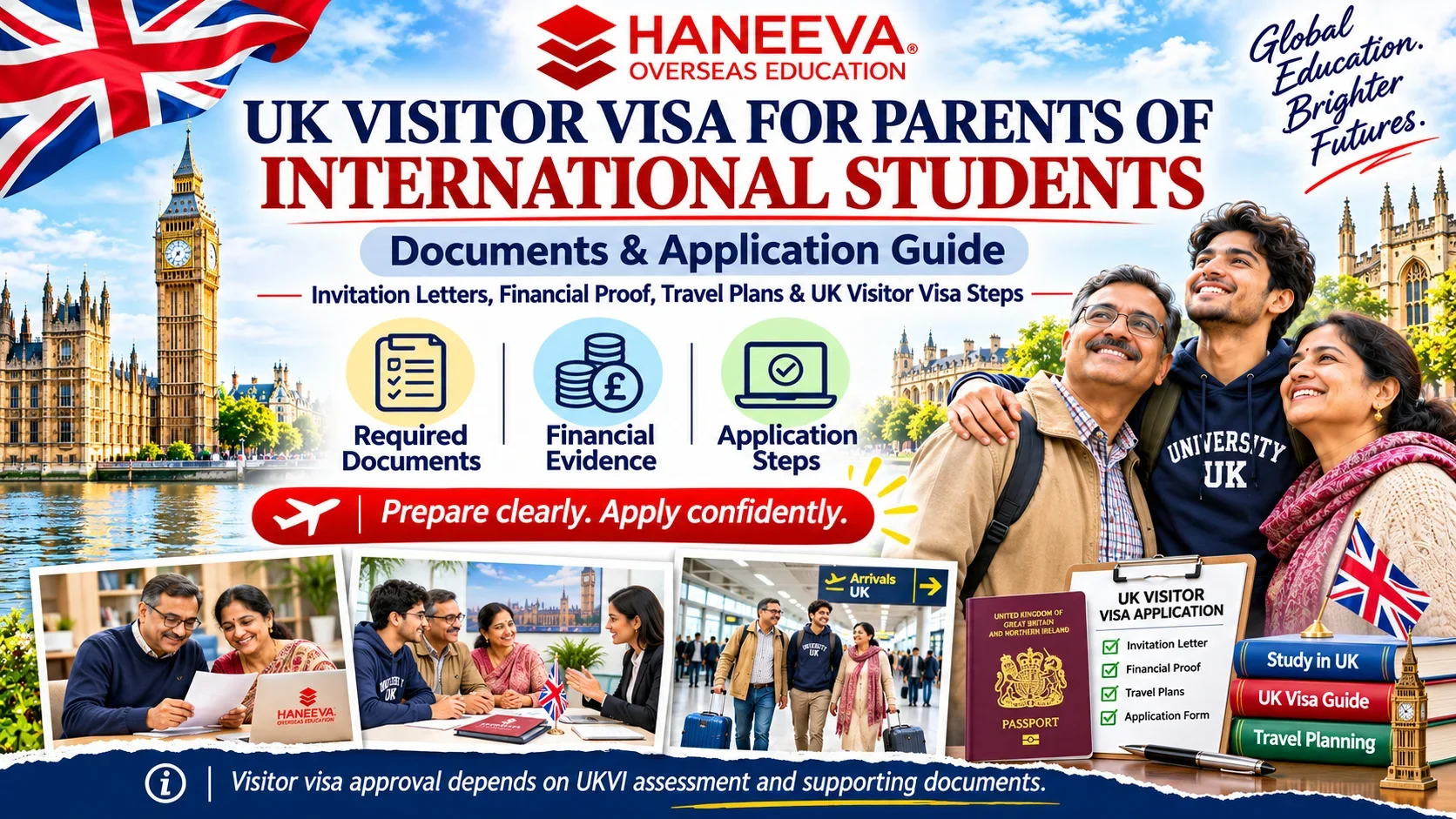
For Indian parents, visiting a son or daughter at a UK university can be one of the most meaningful moments of the family's education journey. Whether the trip is for graduation, a university break or simply time together, the paperwork should reflect a genuine, affordable visit with a clear return plan. HANEEVA Overseas Education supports families through the full visitor-visa preparation process, from the first scanned documents and personalised questionnaire to the online form, document review, payment coordination and visa application centre (VAC) appointment.
HANEEVA's strength lies in organised preparation: identifying the right documents, checking consistency and guiding clients through official procedures. No consultancy has special authority over the decision. UK Visas and Immigration (UKVI) independently assesses every application. This guide explains the UK rules and separates mandatory requirements from HANEEVA's recommended supporting evidence. [1][2]
Can parents visit their child studying in the UK?
Yes. A genuine visit to a child studying in Britain is a permitted family-visit purpose under the Standard Visitor
route. Indian passport holders normally need to obtain the appropriate visa before travel. A parent's application is
separate from the student's UK Student visa, and an invitation from the student does not automatically guarantee
approval. Visitors generally can stay for up to six months per visit, subject to their grant of permission, but cannot
use frequent or successive visits to make Britain their main home. Ordinary family time is permitted; employment
and other restricted activities are not. [1]
The best application begins with a realistic plan: why this trip is needed now, where the parents will stay, who will
meet expenses and what responsibilities they will return to in India. HANEEVA works with parents to develop a
coherent timeline that matches the online answers, cover letter, student invitation and financial evidence.
What UKVI actually assesses
UKVI examines whether the person is a genuine visitor, is undertaking a permitted activity, will leave when the
visit ends and has sufficient funds for travel and everyday costs, either personally or with credible third-party
support. It may assess previous immigration history and the applicant's employment, business or family
circumstances. There is no universal mandatory bank-balance figure for UK visitors. Evidence must be
genuine and proportionate to the trip. [1][2]
A substantial balance is not automatically stronger than a modest balance supported by steady earnings and a
sensible itinerary. HANEEVA helps clients explain salary credits, pension income, business transactions or
legitimate larger deposits where needed. The firm also checks whether a declared trip length is believable in light
of work leave, business continuity and dependent-family commitments.
Start with HANEEVA: initial scanned documents
To open a file with HANEEVA Overseas Education, clients can share clear scans of the first and last passport
pages, earlier UK, US or Schengen visas if applicable, and HANEEVA's completed client questionnaire. These
are HANEEVA intake documents, not a universal UKVI rule about which pages must always be uploaded. The
questionnaire helps collect exact names, passport information, travel history, intended dates, employment,
income, UK contacts and travel funding before the formal online form is prepared.
HANEEVA then checks whether earlier passports, visas, entry/exit stamps or name-change documents are
relevant. UKVI's official guidance recommends previous passports as useful travel-history evidence where
applicable. The passport used for the visit must be valid throughout the intended stay; a blanket requirement for six extra months of validity or three blank pages should not be presented as UK Standard Visitor law. [2][3]
HANEEVA's core UK visitor visa document checklist
The following is HANEEVA's practical file-preparation checklist. The final evidence set is tailored to the
applicant and the document-upload instructions issued for the application. Not every item is required from every
parent.
• Passport and travel history: Current valid passport, relevant previous passports, and copies or scans of useful
previous visas and immigration stamps. HANEEVA can arrange colour scans of every passport page, including
blanks, when requested for a file or upload process; UKVI does not impose this as a blanket requirement on every
Standard Visitor application.
• Application and appointment: Information for the official online form, payment confirmation, appointment
confirmation and any document-upload or VAC instructions issued to the applicant.
• Personal covering letter: A signed, typed letter explaining the parent's name, passport details, relationship to the
UK student, reason for travel, proposed itinerary, funds and expected return to India. HANEEVA can draft this in a
clear, consistent format. A self-employed applicant may use genuine company letterhead; an employed applicant
may sign a plain-paper letter. Neither style is a universal UKVI requirement.
• Family-visit evidence: The student's invitation letter, evidence of the relationship, student identity and immigration
status, current university enrolment confirmation and realistic UK accommodation arrangements.
Originals and photocopies should be carried to the VAC when specified by the appointment instructions,
particularly the passport. Many documents may be uploaded digitally before the appointment; the application
service determines what must physically accompany the applicant. HANEEVA reviews the individual appointment
instructions instead of asking families to carry unnecessary bundles. [3][4]
Financial documents: how HANEEVA prepares a coherent picture
HANEEVA commonly requests six months of personal bank statements, the most relevant three years of
income-tax returns or Form 16, and supporting proof of fixed deposits or other accessible funds where
appropriate. These are a thorough consultancy review standard, not fixed UKVI requirements for every
applicant. Bank stamps and signatures may aid verification in some cases, but reliable electronic bank
statements can also be suitable. The key is evidence of available funds, ordinary income and any significant
transactions. [2]
Assets such as property records, share certificates or long-term investments can explain financial circumstances,
but an illiquid asset is not the same as spending money for the trip. HANEEVA helps families distinguish
accessible savings from investments and prepare a credible trip budget. A parent planning two weeks in a hotel
has different expenses from a parent staying with a student whose accommodation legitimately permits guests.
If another person pays, HANEEVA can prepare a consistent sponsorship explanation supported by the sponsor's
identification, relationship, available finances and, when relevant, evidence of lawful UK residence. UKVI needs to
see what support is offered and whether the sponsor can afford it while meeting personal commitments. A
sponsor letter alone is not enough. [2]
Occupation-specific documents for parents
Employed parents: HANEEVA normally examines the employer's leave-sanction or no objection letter,recent salary slips (often three months), salary credits and income records. The leave period should align with travel dates.UKVI does not require every employer to issue a document with identical wording
Self-employed or business-owner parents: Useful records can include business registration, partnership deed or memorandum of association when relevant, recent invoices, tax returns, company statements and evidence that operations will continue during travel. HANEEVA often reviews six months of business transactions and three years of company tax filings where available, plus an accurate company-letterhead explanation.
Retired parents: Pension statements, retirement letters, investments and accessible savings may establish financial circumstances. HANEEVA helps retired applicants explain their genuine family or community ties without inventing employment obligations.
Freelancers or family-business participants: A truthful statement identifying their activity, role, approximate income and supporting recent bank credits is useful. HANEEVA may request three months of transactions initially and expand the evidence if the income pattern needs explanation.
Students or minors travelling in a related family group: A college ID or enrolment letter can establish student status. For a child under 18, a birth certificate and parental consent or care-arrangement evidence may be important, particularly where one parent is not travelling. Such minor-specific documents are not requirements for an ordinary adult parent visiting their university-age child. [2]
What the son or daughter in the UK should provide
A convincing student invitation usually identifies the parent and student, the student's university and course, lawful
immigration status, UK contact details, proposed visit dates and where the parents will stay. HANEEVA can
structure the invitation and check consistency with the parent's application. Useful attachments include a passport
identity page, current immigration permission or eVisa evidence as appropriate, an enrolment letter, and
confirmation of the UK address. Graduation or university-event details can help explain timing.
If the student is promising accommodation, the arrangement must be genuine. A university residence or shared
rented room may restrict overnight guests. Parents using a hotel should say so. The student's bank statement
should be included as sponsorship evidence only when the student is actually providing financial support; it is not
automatically required merely because the student wrote the invitation.
Other papers that may apply to specific journeys
A marriage certificate or related identity evidence may help where family names or relationships need explaining.
The special wedding-card, bridal-parent NOC and photographs sometimes found on generic checklists are not
standard documents for a parent's UK family-visit visa. If the purpose is to marry or register a civil partnership
in Britain, a different visa category may be required. Similarly, a UK company invitation and an Indian employer's
covering letter are relevant when the real visit includes permitted business activities, not automatically for a
family visit. [1][2]
HANEEVA can assist clients with optional travel insurance suited to their itinerary, but UK Standard Visitor rules
do not impose the Schengen-style minimum €30,000 insurance cover. UKVI's guidance treats travel
insurance as generally low-value visa evidence; insurance may still be a sensible private travel purchase.
HANEEVA distinguishes useful personal protection from documents required for visa eligibility. [2]
HANEEVA's step-by-step application support
Step 1 - Intake and document collection. The family shares initial passport scans, previous visa records and the
HANEEVA questionnaire. HANEEVA creates a case-specific checklist and identifies missing or conflicting details.
Step 2 - Document review and drafting. HANEEVA examines finances, employment or retirement records, the
student invitation, accommodation, proposed itinerary and cover letter. Clients review and confirm their own facts before submission
Step 3 - Official online form. With applicant authorisation, HANEEVA assists with completing the UK Standard
Visitor form, checking biographical information, travel history, refusals, funding and address details. Each parent
needs a separate application. [3]
Step 4 - Fee payment and VAC booking. HANEEVA helps clients navigate the official payment and appointment
steps. As checked on 16 November 2026, the six-month Standard Visitor fee is £135 per applicant, and
applications may ordinarily be lodged up to three months before travel. Optional VAC or priority charges depend
on the service and location. [3][4]
Step 5 - Documents and biometrics. HANEEVA can organise digital uploads, or help clients understand optional
paid document-scanning services at the VAC. Applicants typically attend the VAC themselves for a photograph,
fingerprints and identity checks. Paying for scanning does not improve approval chances. [4]
Step 6 - Updates and the decision. HANEEVA helps families keep copies of the final application, uploaded
documents, appointment details and correspondence. Normal published processing is often around three weeks after identity verification, but checks and demand can extend the period. Only UKVI issues the visa decision;
HANEEVA cannot guarantee or independently accelerate it through government contacts. [3][5]
Common errors HANEEVA helps families avoid
An application may become difficult to assess when declared income differs from bank credits, an employer
records different travel dates, the UK address does not match the invitation, or a sponsor promises support
without showing capacity. HANEEVA reviews these connections before submission. Any previous refusal or
immigration issue must be disclosed truthfully; a new passport does not erase the history.
Other avoidable mistakes include purchasing non-refundable tickets too early, claiming a fixed bank-balance rule
that UKVI does not have, treating property values as immediately spendable money, and submitting irrelevant
stacks of photographs or notarised documents. UKVI specifically lists routine flight bookings, hotel bookings, travel
insurance and some notarised or personal documents as generally unhelpful visa evidence. A focused file can be
clearer than an oversized one. [2]
Seven common questions from parents
1. Can both parents apply together? They may plan the same trip and share genuinely common supporting
evidence, but each parent needs their own Standard Visitor application and visa fee.
2. Is there a mandatory six-month bank balance? No. HANEEVA may review six months of statements as a
preparation standard, while UKVI assesses credible funds and the circumstances of the actual visit.
3. Is a student invitation compulsory? It is useful supporting evidence when visiting a child, but it does not
replace the parent's own eligibility. A special university-issued invitation is not universally required.
4. Must all statements be stamped by a bank? No blanket rule makes stamped paper statements essential for
every visitor. Clear, verifiable electronic records can be acceptable.
5. Is UK travel insurance mandatory? It is not generally a Standard Visitor visa condition. The €30,000
Schengen threshold is not a UK visitor visa rule.
6. Can HANEEVA guarantee a fast approval? HANEEVA can improve preparation efficiency and assist with
official application steps; processing times and decisions belong to UKVI. Applicants may select an eligible official
priority service where available.
7.What if a parent has no job or pension? They may still apply with honest evidence of savings, appropriate
family sponsorship, their circumstances and a believable temporary-visit plan.
Choose HANEEVA for structured parent-visitor visa preparation
The purpose of HANEEVA Overseas Education's service is to make a complicated application clearer, more
accurate and easier for families to manage. HANEEVA helps clients collect and check supporting evidence,
prepare invitation and cover letters, complete the official application with authorisation, coordinate document
uploads, navigate payments and secure a suitable VAC appointment. It keeps the focus on the client's genuine
circumstances rather than promises that no adviser can make.
If your son or daughter is studying in the UK and you are planning a family visit, contact HANEEVA Overseas
Education at www.haneeva.com for a personalised document review and application-preparation plan. The
application remains the parent's responsibility, and the final decision rests with UKVI.