Scholarships
Study in South Korea 2027: GKS Scholarship, Universities, Fees & Student Visas
Planning to study in South Korea in 2027? Explore GKS scholarships, universities, tuition and living costs, student visas, undergraduate notices and graduate planning with HANEEVA.
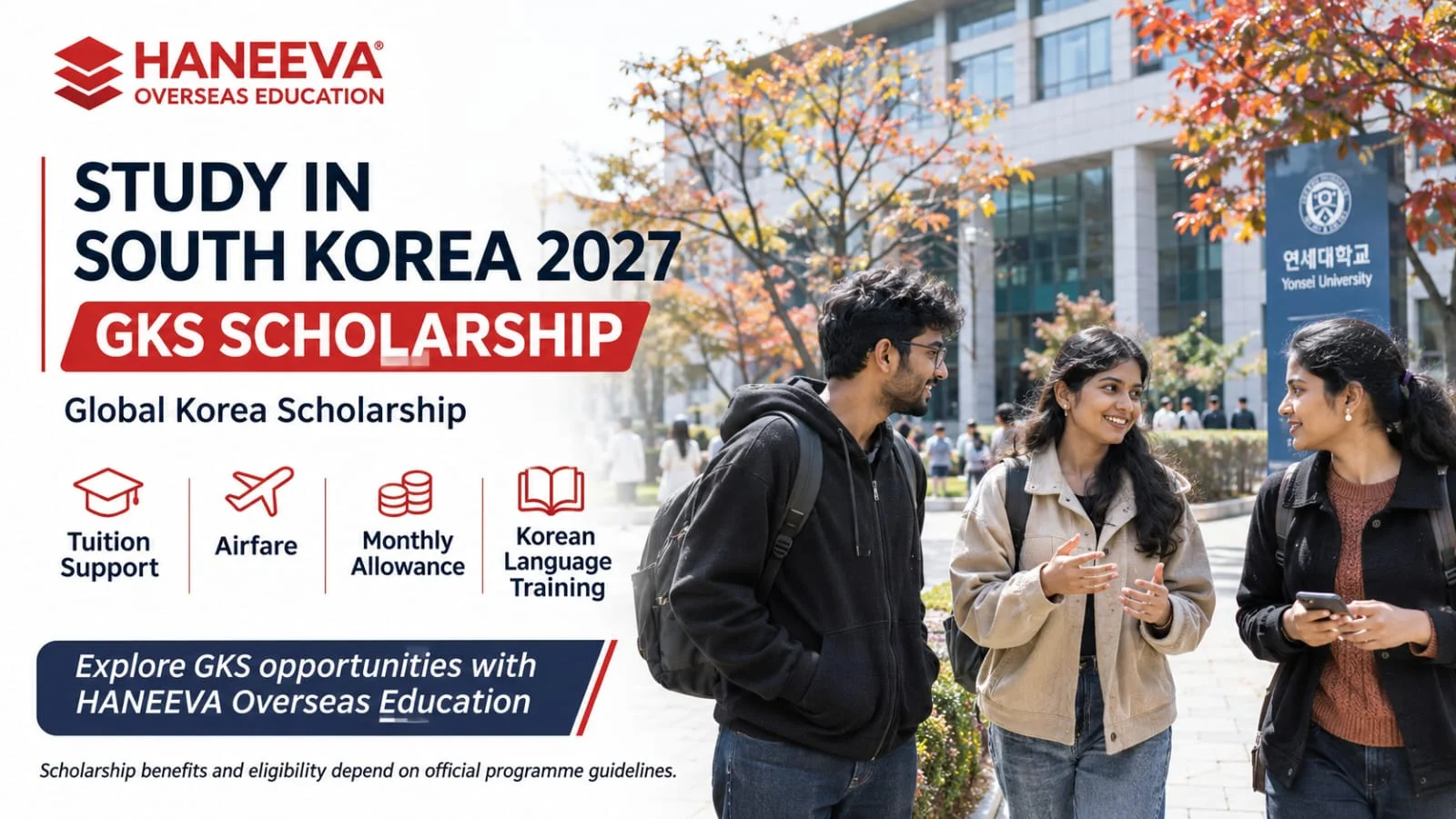
South Korea has become an exciting option for Indian students who want a serious academic experience alongside exposure to advanced technology, research and international culture. From engineering and artificial intelligence to business, design, biotechnology and Korean studies, the country offers a varied university landscape. The biggest opportunity for many applicants is the Global Korea Scholarship, usually called GKS, which can help eligible international students pursue a degree with substantial financial support. This HANEEVA Overseas Education guide explains what is confirmed for 2027, what is still pending and how to build a credible study plan.
Why choose South Korea for higher education?
Korea's universities connect classroom study with industries including electronics, automotive engineering, semiconductors, digital services and entertainment. Students can explore research universities, comprehensive institutions and universities of applied sciences across Seoul and regional cities. Location matters: Seoul offers a large metropolitan environment, while places such as Busan, Daejeon, Daegu and Gwangju can provide different campus settings and living budgets. Choose on programme quality, teaching language, laboratory access and research fit rather than a famous city name alone.
International students can benefit from student clubs, university career centres, academic mentoring and cultural activities. Living in Korea also offers opportunities to learn Korean and develop cross-cultural communication skills. None of these benefits automatically translates into a job offer. The strongest outcome comes from combining a suitable degree with projects, language ability, internships when permitted and consistent academic performance.
What is the Global Korea Scholarship?
GKS is a scholarship programme administered by South Korea's National Institute for International Education, or NIIED, under the Ministry of Education. It supports selected international students in degree programmes at participating Korean universities. Depending on the programme and current guidelines, benefits can include tuition support, Korean-language training, airfare and study allowances. It is highly competitive and does not mean every student studying in Korea receives government funding. The exact monetary amounts and eligibility conditions must be taken from the relevant year's official guideline, not an old promotional chart.
There are two main degree routes: GKS-U for undergraduate or certain associate-degree studies, and GKS-G for graduate study, including master's and doctoral routes. The programmes have different entry qualifications, age limits, participating universities, selection schedules and track rules. A student finishing Class 12 should not follow a master's scholarship checklist; a graduate should not rely on undergraduate application deadlines.
Critical update: what is actually confirmed for 2027?
As of 22 November 2026, NIIED has published the official 2027 GKS undergraduate application guidelines. Korea's education authorities also released university-specific University Track selection information. This means undergraduate applicants should consult the 2027 notices now, rather than wait for another general announcement. The 2027 Embassy Track online application window ran in September 2026, so that initial stage has already passed. University Track application schedules are set by participating institutions and must be checked individually; some may also have closed.
The general 2027 GKS graduate scholarship call was not available in the official notices checked for this article. For planning, the 2026 GKS-G guidance shows that graduate recruitment normally takes place in the first part of the year, but its quotas, documents, dates and financial benefits must not be advertised as confirmed for 2027. Applicants should monitor the Study in Korea GKS notice board and the Embassy of the Republic of Korea in India for the next official graduate announcement.
Who may qualify for GKS?
NIIED's GKS overview describes a basic undergraduate profile involving non-Korean citizenship for applicants and parents, completion or expected completion of qualifying secondary education, an age limit generally under 25, and strong prior academic performance, usually at least 80 percent or an accepted equivalent. Graduate applicants normally need a relevant bachelor's or master's qualification, an age limit generally under 40, and comparable academic performance. These are starting points, not a complete 2027 decision tree. The official guidelines describe permitted GPA scales, documentary alternatives, exceptions and special tracks.
For Indian students, Class 12 boards, university grading systems and final-result dates deserve particular attention. A percentage cannot always be converted directly into another institution's CGPA. An applicant who is still awaiting results must check the permitted graduation deadline and final-document submission rules. Previous Korean government scholarship history, dual citizenship, health declarations and programme-specific eligibility can also affect an application. HANEEVA helps students organise an eligibility review without representing that the scholarship selection committee has pre-approved their profile.
Embassy Track versus University Track
Under the Embassy Track, applicants follow the Korean diplomatic mission's instructions and the official Study in Korea procedure for that intake. Selection can involve screening at the embassy, review by NIIED and evaluation by universities. Under the University Track, applicants submit directly to an eligible participating university according to its published directions. University Track options may focus on particular academic fields or institutions. The number of university choices, submission method and required documents can differ between tracks.
Applicants should not submit inconsistent duplicate applications or assume they can apply through unlimited tracks. Read the specific rules for the scholarship year. A participating institution for one track may not accept your proposed major under another track. For Indian applicants, the Korean Education Centre India's official GKS-U announcement is a useful starting point, alongside NIIED's university information files.
Universities and programmes worth exploring
Well-known Korean institutions include Seoul National University, Korea University, Yonsei University, KAIST, POSTECH, Sungkyunkwan University, Hanyang University and Pusan National University. Their programmes, languages of instruction and GKS participation vary by year and track. These names are examples of the broader higher-education landscape, not a promise that every named department has a 2027 GKS seat. Applicants must select from the official university and department list published for the relevant scholarship route.
Beyond a university's reputation, inspect module descriptions, laboratories, thesis expectations, industry projects, academic calendars and graduation requirements. Engineering students might prioritise technical facilities; business students may value analytics or international management coursework; creative students should check studio access and portfolio requirements. A precise academic match is more persuasive than applying to an unrelated course simply because it appears on a scholarship list.
Korean-language and English-taught programmes
Not every degree in Korea is delivered in English. Some programmes are Korean-taught, some offer English-medium courses and some mix languages. GKS degree routes often include Korean-language training, subject to exemptions or programme-specific arrangements. Students should verify the TOPIK expectations for language training, academic progression and degree completion. An English-medium advertisement does not automatically eliminate Korean-language requirements elsewhere in the student's experience.
Strong Korean ability can also make everyday life easier, from housing and banking to teamwork and professional networking. Where a university asks for TOEFL, IELTS or other language evidence, check accepted tests and validity periods directly. HANEEVA can compare a student's existing certificates against published admission rules and help identify genuine missing requirements, without claiming an unverified language waiver.
Discuss scholarship opportunities
Explore Haneeva guidance for your next step.
Scholarship CounsellingHow much does studying in Korea cost without GKS?
Costs vary widely by institution, course and city. The Korean government's Study in Korea portal lists an undergraduate national tuition average of roughly KRW 6.82 million per year, compared with about KRW 4.27 million at national and public universities and KRW 7.63 million at private institutions. These are published national averages, not individual 2027 fee quotations. Engineering, medicine and arts may differ materially.
The same government portal presents a broad monthly living-cost illustration of approximately KRW 750,000 to 1,000,000. Actual expenses may be higher for private housing in Seoul, deposits, travel, insurance or personal spending. Dormitory accommodation may lower costs, but availability and meal plans vary. Budget separately for flights, residence procedures, winter clothing, textbooks, phone service, emergency funds and initial settling-in costs.
A GKS award may cover major budget categories, but do not assume every incidental cost disappears. Students should review when allowances are disbursed, what tuition components are covered, any initial expenses before payment and whether their programme carries extra charges. International banking arrangements and exchange-rate movements also matter to families in India.
Documents Indian students should prepare
Start with a passport, official Class 10 and 12 records or undergraduate transcripts, degree or provisional certificates where relevant, proof of nationality and family relationship when requested, and a reliable official grading explanation. The GKS forms can require personal statements, study plans, recommendation letters and medical declarations. Certified translations, apostilles or document authentication may be necessary depending on the current guidelines. A university may request additional material such as a portfolio or research proposal.
Check exact names and dates throughout the record. An affidavit cannot automatically replace a document specifically required by NIIED. The right approach is to obtain genuine certificates and verify acceptable alternatives before the deadline. For graduate research interests, draft a specific proposal that connects your education to the department's available expertise rather than sending the same generic statement to every university.
The GKS application journey, step by step
First, identify whether you are applying for undergraduate or graduate funding and download the correct official year guidelines. Second, confirm citizenship, academic results, age and qualifying graduation date. Third, shortlist eligible universities and departments under the chosen track. Fourth, prepare authentic academic records, statements, recommendations and certified documents. Fifth, submit through the authorised embassy or university channel by its published deadline. Sixth, monitor interview invitations, later-round results and final document requests. Only after receiving official scholarship and admission instructions should you finalise travel and visa planning.
A strong personal statement explains your academic preparation, specific learning goals, reasons for choosing Korea and realistic plans for applying the education later. Avoid claiming that K-pop interest alone proves academic suitability. Explain relevant projects, research, volunteering or leadership truthfully. Scholarships assess candidates through their stated criteria; no consultancy can guarantee selection or expedite an NIIED decision.
Student visa, work rights and life after graduation
South Korea generally uses the D-2 category for degree-level international study and D-4 for certain non-degree training, including Korean-language study. Visa applications require the admission documentation and other evidence applicable to the particular category and diplomatic post. A scholarship award should not be presented as automatic immigration permission. Students may need to complete foreign-resident registration and comply with reporting rules after arrival.
Part-time employment is not unrestricted. Government guidance indicates that eligible D-2 and D-4 students must satisfy conditions, which can include Korean proficiency, university confirmation and prior immigration permission. Permitted hours and job categories depend on status and circumstances. Do not budget for guaranteed part-time wages or begin work without authorisation. Graduation also does not automatically provide a permanent job or residence pathway.
How HANEEVA Overseas Education supports applicants
HANEEVA Overseas Education helps Indian students approach South Korean admissions and GKS opportunities with a clear, organised strategy. Support can include profile screening, programme shortlisting, identifying the correct scholarship track, checking document consistency, drafting personalised statements of purpose and study plans, and preparing for admission interviews. HANEEVA can help families compare scholarship funding with self-funded alternatives and coordinate the university application checklist.
The team can also guide students in locating official NIIED updates, university contact information and applicable visa documentation. This assistance is valuable precisely because university and scholarship policies differ: a properly checked shortlist can prevent wasted applications and missed requirements. HANEEVA is an independent admissions-support provider; it does not award GKS funding, control NIIED rankings, promise seats or make Korean immigration decisions.
Frequently asked questions about Study in South Korea 2027
Is the 2027 GKS undergraduate scholarship announced? Yes. NIIED published 2027 GKS-U guidelines in September 2026. The Embassy Track initial application period has passed, while university-specific schedules require individual checks.
Has the 2027 GKS graduate scholarship opened? No general 2027 GKS-G call was verified by the article's research date. Follow NIIED and the Korean Embassy rather than assuming old dates are current.
Does GKS cover tuition and living costs? The programme includes major benefits such as tuition, language training, airfare and allowances, subject to the specific year's rules and award conditions.
Do I need Korean before applying? Requirements differ by scholarship category and programme. Korean training may form part of the award, while a specific department may have separate language rules.
Can I choose any Korean university? No. The official GKS track list determines eligible institutions and departments.
Can I work during my degree? Only if your immigration status and the applicable part-time employment rules permit it, with any required prior approval.
Can HANEEVA guarantee a GKS scholarship? No. HANEEVA can support preparation and applications, but award decisions belong to NIIED and the participating institutions.
Final Verdict: Your 2027 South Korea Study Plan
South Korea offers compelling academic opportunities, and GKS can make them much more accessible for students who meet its competitive standards. The most important next step is timing: 2027 undergraduate information is already available, while general 2027 graduate information must be monitored. Choose a course that fits your record, prepare genuine evidence and build a realistic budget. HANEEVA Overseas Education can help you turn that research into an organised university and scholarship application plan.
Related guides
Ask Haneeva about study-abroad guidance
Discuss your study plans
Tell our team what support you need.