Study Destinations
Study in Malta 2027: Beyond the UK and Ireland for Indian Students
Looking beyond the UK and Ireland for 2027? Explore Malta universities, Business, IT, Hospitality and Finance programmes, living costs, student work rules and admissions with HANEEVA.
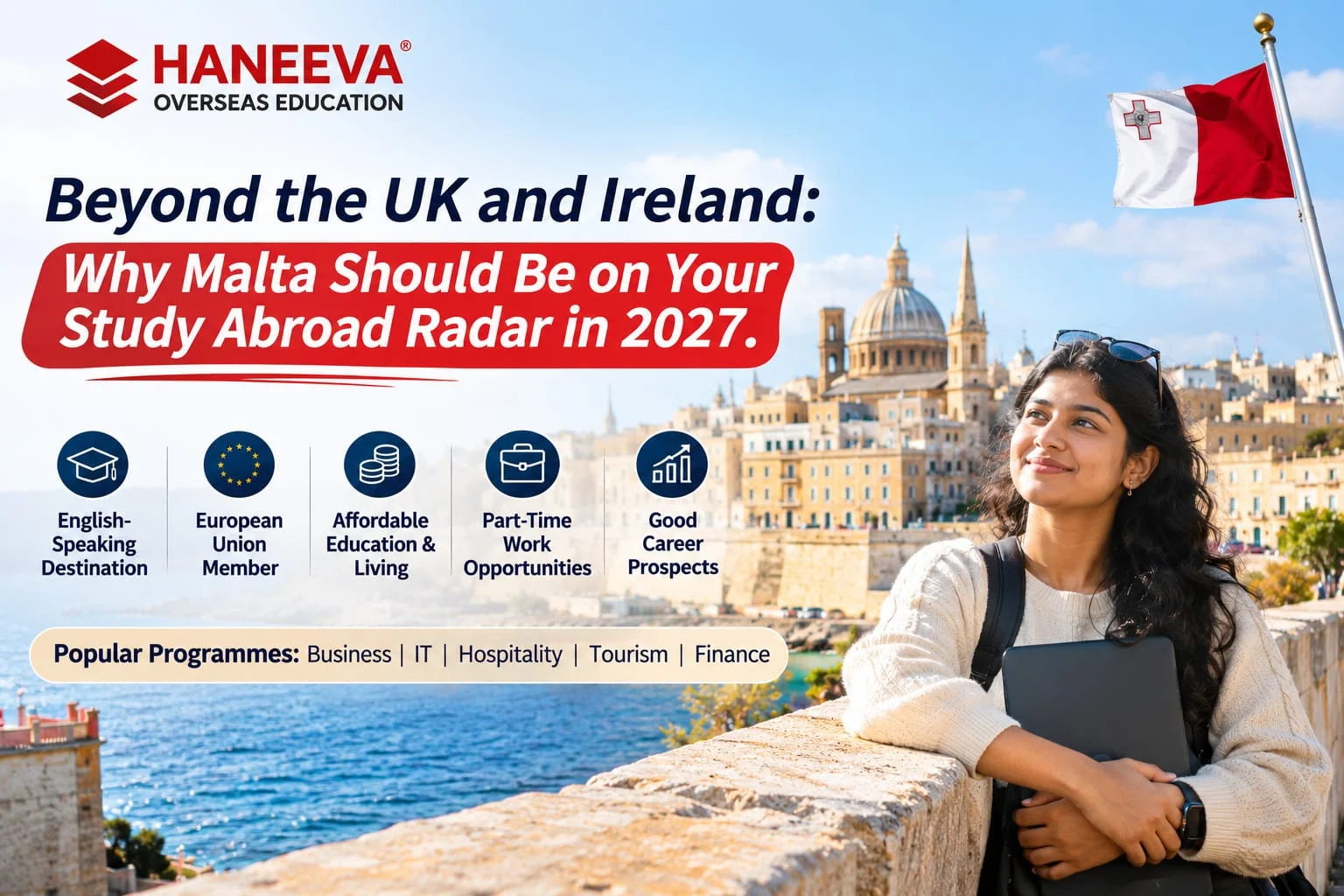
Picture studying in a Mediterranean country where English is an official language, historic streets lead to the sea, and international students can explore European higher education. For students who have only considered the UK or Ireland, Malta may be an unexpected addition to their shortlist.
Malta is small, but it offers a distinctive combination of English-language education, European Union membership and courses connected to sectors such as business, computing, tourism and financial services. That does not mean every programme is affordable or that employment is assured. It means Malta is worth comparing carefully with other destinations for the 2027 intake.
1. Why Malta deserves attention in 2027
Malta has been a European Union member since 2004, uses the euro and belongs to the Schengen Area. Maltese and English are its official languages. For Indian students, the use of English can make academic communication and many daily activities easier than in destinations where most services operate in another language.
The country also offers a different lifestyle: compact cities, a Mediterranean climate, historic architecture and a sizeable international community. Students should nevertheless think about housing availability, transport, course quality and their career plans rather than choosing a destination because it looks attractive in photographs.
2. Where can you study? Check recognition first
University of Malta
The University of Malta is the country’s principal public university and offers undergraduate and postgraduate programmes across fields such as management, computing, sciences, humanities and other disciplines. Its official admissions page confirms that applications for courses beginning in February 2027 and October 2027 are open. Not every course has both entry points.
Malta College of Arts, Science and Technology (MCAST)
MCAST is a major public vocational and applied education institution. Its programme portfolio can be relevant to students interested in technology, engineering, business and practical, career-oriented study. Students must confirm whether a particular qualification, intake and study level meet their goals and immigration requirements.
Institute of Tourism Studies (ITS)
ITS is a specialised institution worth investigating for hospitality, tourism and related fields. Course levels, placement components, availability and fees should be checked directly with the institute.
Private higher education providers
Malta also has private institutions offering selected programmes, but students should never assume that every advertised provider or course has the recognition they need. The Malta Further & Higher Education Authority (MFHEA) maintains a database of licensed institutions and accredited programmes. Verify both the provider and the specific qualification before paying a deposit.
3. Popular programmes for Indian students
Business and management: Students can explore management, marketing, entrepreneurship and business administration. Compare modules, assessment style and actual employer connections.
IT and computing: Depending on the institution, options may include software development, information systems, cybersecurity and data-related subjects. Look beyond the course title to the technical curriculum.
Hospitality and tourism: Malta’s tourism economy makes hospitality and tourism education an obvious area to investigate. Practical training arrangements and industry placements must be confirmed for each programme.
Finance and related disciplines: Accounting, finance and business-related qualifications may appeal to students interested in professional services. Check professional recognition, exemptions and employer requirements separately.
The best programme is the one that fits your previous education and future career plans, not simply the one with the most appealing marketing.
4. Tuition fees and living costs: budget realistically
There is no single reliable tuition figure for all Maltese universities and private providers. The University of Malta publishes course-specific tuition in its official course search, and payment schedules appear in individual offers. Indian applicants normally need to assess the non-EU fee category and check whether any deposits are refundable.
Living costs can be substantial. The University of Malta currently gives the following approximate monthly examples; these are planning estimates, not a visa minimum or guaranteed prices:
| Expense | Indicative monthly estimate |
|---|---|
| Shared accommodation | EUR 550-700 |
| Single accommodation | EUR 800-1,600 |
| Food and beverages | Around EUR 450, excluding eating out |
| Mobile / Wi-Fi | Around EUR 30 |
| Laundry | EUR 80-100 |
| Utilities | Around EUR 50 at basic usage; may be higher |
| Other personal expenses | EUR 200-300 |
A student sharing accommodation and managing expenses carefully may spend less than someone renting alone, but budgeting only for the lowest advertised rent is risky. Include tuition, insurance where required, visa fees, flights, initial deposits, books and an emergency reserve. Do not depend on finding a part-time job to pay essential bills.
5. Intakes and application deadlines for 2027
The University of Malta has confirmed that applications for February 2027 and October 2027 courses are open. Its published admissions information points applicants to course lists and its dates-and-deadlines page for the relevant programme. The university’s English-language requirements page also lists separate test-result submission deadlines, including 1 July for visa-requiring non-EU applicants for the October intake; this is a language-evidence deadline, not necessarily the final course-application deadline.
Other institutions and private providers may have different intake structures and closing dates. Indian students should begin with the exact course page, check admission and document deadlines separately, and allow time for visa processing, financial documentation and accommodation arrangements. Do not assume a February intake exists for every degree.
6. Is IELTS compulsory?
English being an official language does not remove university English-proficiency requirements. The University of Malta states that applicants educated overseas generally must meet its Secure English Language Test requirements, subject to published exemptions. It accepts specified tests including IELTS and TOEFL, with minimum scores depending on study level and course.
For a private institution or another public provider, check its own admissions rules and the visa evidence required for your circumstances. A claim that a course is “IELTS-free” is not enough to establish that no English-language evidence will be needed.
7. Scholarships and financial planning
Scholarships may be offered by individual institutions or through targeted calls, but they are not guaranteed. At the time of this review, the University of Malta’s general scholarships page states that no scholarships are currently available and that future opportunities will be announced there. Applicants should monitor course-specific funding and scholarship announcements rather than assuming a general award exists for 2027.
Prepare a funding plan that works without a scholarship: compare full tuition, deposit conditions, living costs and the documents required to prove financial resources. Families should also consider exchange-rate movements and unexpected costs.
8. Can international students work part-time?
Malta’s official Identità guidance explains that eligible non-EU students can work up to 20 hours per week, subject to the correct student status and an employment licence from Jobsplus. The exact point at which work is permitted can depend on the type of study authorisation and applicable rules. Students should not start work before the required permission is issued.
Part-time vacancies depend on skills, season, language, employer demand and competition. Earnings should be treated as possible additional support rather than guaranteed income. Unauthorised work
can jeopardise immigration status.
9. Post-study opportunities: what happens after graduation?
Malta’s Identità guidance describes a one-time post-study residence option of up to nine months for eligible non-EU graduates who complete a recognised qualification at MQF Level 5 or above and satisfy the applicable conditions. This is intended for looking for employment or establishing a qualifying business; it is not an automatic work permit or a guarantee of a job.
A graduate who secures qualifying employment will generally need the relevant employment-based authorisation. The fact that Malta is in the EU does not give a non-EU graduate unrestricted rights to work in other EU countries.
10. Student visa and residence requirements for Indian applicants
Indian nationals intending to study long-term in Malta generally need the appropriate national long-stay (Type D) study visa before travel, followed by the relevant residence procedure after arrival. Identità explains that study residence permits generally relate to qualifying full-time programmes at recognised institutions and sets out documentation and eligibility rules.
A typical application preparation process includes a valid passport, admission confirmation, evidence of tuition arrangements, adequate financial resources, accommodation details, insurance where applicable, academic records and other documents requested by the authorities. The exact checklist depends on the visa category and circumstances. An offer letter alone does not guarantee visa approval.
11. Malta vs the UK and Ireland: a practical comparison
Language: Malta, Ireland and the UK all offer English-language study options, but English is also an official language in Malta. The language of instruction and proof requirements remain course-specific.
Education choice: The UK and Ireland have larger university systems and more extensive selections in many specialist disciplines. Malta offers a smaller set of institutions and programmes; that can suit some students but limits choice for others.
Costs: Malta can offer competitively priced programmes, yet accommodation and living expenses should not be assumed lower than in every UK or Irish city. Compare actual offers and budgets.
Career planning: Each destination has its own employment market, student work rules and graduate immigration pathways. A post-study residence option is not a promise of employment or permanent residence.
For students who want an English-speaking European environment and find a programme that fits their profile, Malta can be a meaningful alternative. For others, a UK or Irish institution may offer a better academic or professional match.
12. The challenges worth discussing openly
Malta’s smaller size means a more limited selection of specialised degrees and a smaller labour market than larger countries. Housing costs, especially in sought-after locations, can be higher than students expect. Students should also consider the intensity of the tourism season, local commuting, programme recognition and whether the qualifications meet requirements in India or other countries where they may later work.
A well-informed decision looks at both advantages and limitations. The goal is not to find a destination with no challenges, but one whose trade-offs make sense for you.
13. How HANEEVA Overseas Education helps students
For students considering Malta for the first time, the most difficult part is often knowing where to begin. HANEEVA Overseas Education helps turn that uncertainty into a more structured plan, from comparing destinations to preparing a genuine and consistent application.
Profile evaluation and university shortlisting
HANEEVA helps students assess academic history, preferred subject, budget and long-term goals, then compare suitable institutions and courses. For Malta, this should include checking the institution and qualification against official MFHEA recognition records.
Course and admissions guidance
Students can receive help reviewing course requirements, preparing application timelines, understanding offer conditions and organising the supporting documents requested by their chosen institution.
SOP, CV and document preparation
HANEEVA supports students with authentic statements of purpose, CV presentation, recommendation-letter guidance and consistency checks across their application materials. All submitted information should accurately reflect the applicant’s own background.
Scholarship and financial planning
Guidance can include comparing tuition and living expenses, checking actual scholarship eligibility, understanding education-loan options and assembling financial documentation. No scholarship or loan approval should be assumed.
Visa documentation and pre-departure support
HANEEVA can help students understand the official visa checklist, prepare supporting records, plan timelines and organise pre-departure matters such as accommodation and travel. The Maltese authorities alone decide whether a visa or residence permit is granted.
Final Verdict: Is Malta right for your 2027 study plan?
Malta is not simply a cheaper version of the UK or Ireland. It is a different destination with its own institutions, economy and immigration framework. Its English-speaking environment, EU setting and selected programmes make it worth exploring, particularly for students interested in business, computing, hospitality, tourism and finance.
But the right choice depends on the exact course, recognition, total cost and your future plans. If those factors align, Malta could be a rewarding place to begin your next chapter.
Explore Malta with HANEEVA Overseas Education. Compare your options, understand the requirements and take the next step with a clearer plan.
Ready to compare your options? Contact HANEEVA Overseas Education or call +91 81055 41166 for personalised course and application guidance. Fees, deadlines and immigration rules can change; confirm current requirements before applying or paying. Admission, funding and employment are not guaranteed.
Related guides
Explore Malta
Destination guideAsk Haneeva about study-abroad guidance
Discuss your study plans
Tell our team what support you need.