Education Loans
Education Loan for Studying Abroad in 2027 Collateral, Interest Rates & Documents
Planning to study abroad in 2027? Discover how education loans can help finance your international education. Compare secured and unsecured loans, collateral requirements, interest rates, EMI options, repayment periods and essential documents. Explore smart financing strategies, scholarships and loan eligibility
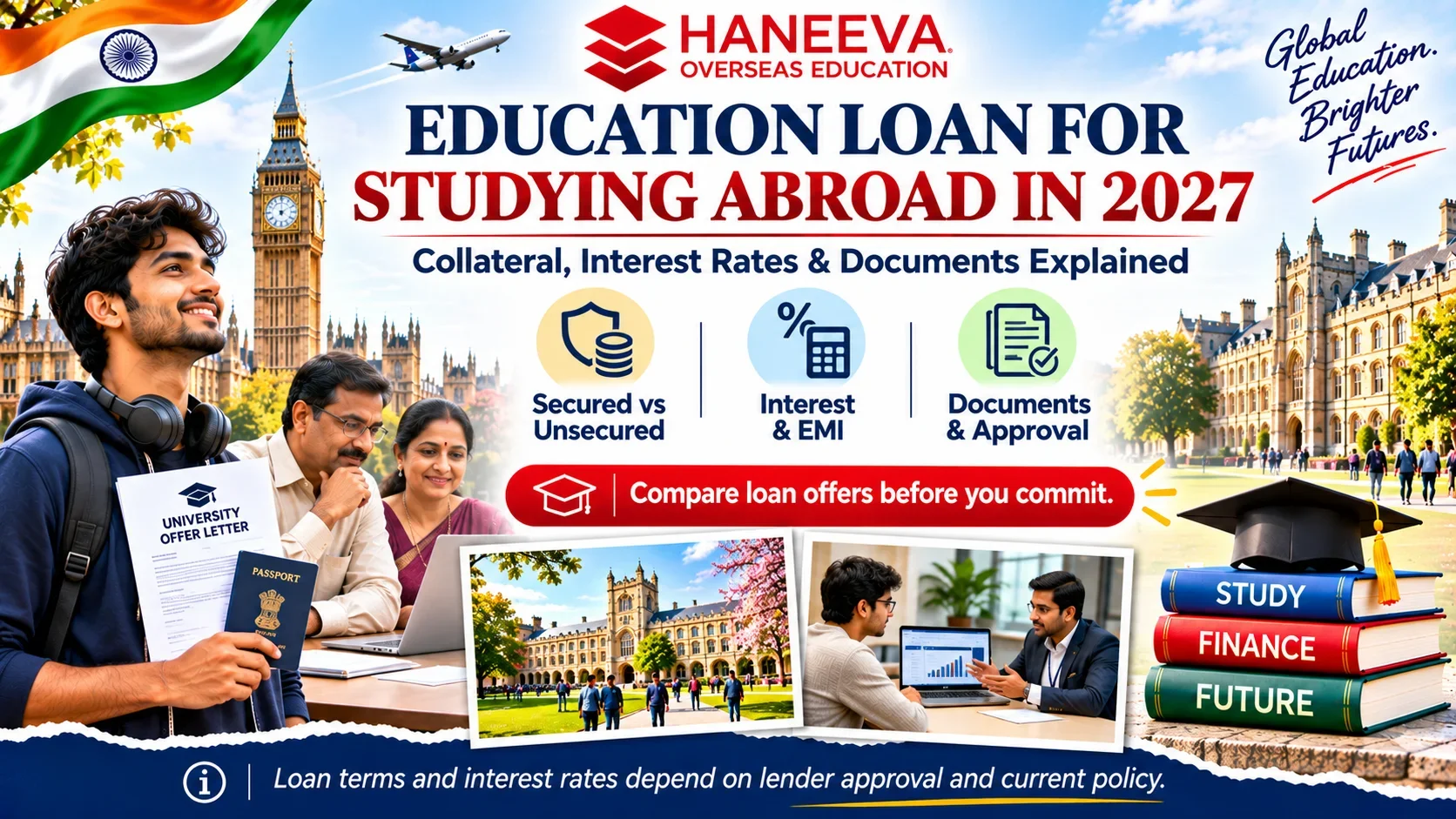
Education Loan for Studying Abroad in 2027:
Collateral, Interest Rates & DocumentsAn international degree needs a funding plan, not just an admission letter
Studying abroad can open doors to specialised teaching, research facilities, international networks and
experiences that shape a career. An education loan can make those opportunities accessible when savings
alone cannot cover the full cost. Yet borrowing should start with a careful calculation, not an advertisement
promising instant approval. Indian students planning overseas education in 2027 need to understand
collateral, interest, co-applicants, documentation, repayment and currency risks before signing. Loan
approval depends on the applicant, course, institution, security and lender policy; admission and future
employment are never guaranteed.
How much should you actually borrow?
Start with the official university offer and a complete course budget. Include tuition, compulsory academic
charges, accommodation, meals, local transport, health insurance, visa fees, travel, initial deposits,
learning equipment and a realistic emergency buffer. Separate confirmed costs from estimates. Convert
overseas amounts using a cautious exchange-rate assumption, since rupee depreciation can increase
funding needs after sanction. Check whether the lender pays tuition directly to the university and how
living expenses are released. Scholarships, assistantships and family contributions reduce borrowing, but
an anticipated scholarship is not money in hand.
Secured and unsecured education loans: the real difference
A secured education loan uses acceptable collateral, commonly property or other eligible financial assets,
as additional security. Lenders assess ownership, title, valuation, existing charges and the legal ability to
create a mortgage. Secured loans may support a larger amount or a more favourable rate, but the pledged
asset is exposed if repayment fails. An unsecured, or collateral-free, loan relies more heavily on the
university, course, student's record, co-applicant income, credit history and repayment assessment. It may
have higher pricing, tighter eligibility or a lower limit. Collateral-free does not mean document-free,
co-applicant-free or approval-guaranteed.
The Reserve Bank of India's education-loan FAQ says scheduled commercial banks must not demand
collateral for education loans up to ₹4 lakh. This is not a universal promise of large unsecured overseas
loans. Under their own products, lenders can offer greater collateral-free amounts to selected institutions.
For example, SBI's Global Ed-Vantage product advertises collateral-free loans up to ₹50 lakh for students
entering specified premier institutions, subject to its conditions. Ask the lender to confirm the exact
scheme, institutional category and security requirement in writing.
What can count as collateral?
Depending on the bank and product, acceptable security may include residential property, commercial
property, certain deposits or other approved liquid assets. Family-owned agricultural land, jointly owned
property, inherited property and assets with an existing mortgage need special scrutiny; never assume
they qualify. A property loan usually triggers document review, legal opinion, valuation and registration or
creation of charge. Those steps can involve time and costs. Ask who pays legal and valuation fees, what
percentage of collateral value is required, and when the charge will be released following complete
repayment. Never submit fabricated title records or conceal an existing mortgage.
Education loan interest rates in 2027: compare the formula
There is no single RBI-prescribed education-loan interest rate for all banks. RBI says scheduled commercial
banks set lending rates under their approved policies. A loan may have a floating rate linked to an external
benchmark or a product-specific reference rate, with a spread added. A lower advertised starting rate
might apply only to selected universities, security categories or borrowers. Your sanction letter should
show the effective annual rate, benchmark, spread, reset frequency, fees, insurance conditions and
applicable concessions. Request a written illustration showing what happens if rates increase by one or two
percentage points.
As a dated example, SBI's published education-loan interest page, marked effective 15 June 2025, listed
Global Ed-Vantage secured lending at 9.15% and a selected-institution secured category at 8.65%. These
are historical published examples, not verified offers for 2027. Bank of Baroda's Baroda Scholar page
presents floating-rate formulas based on its benchmark and classification, rather than a reliable single rate
for every applicant. Ask for current lender-generated quotations on the same date, using the same
principal, repayment term and interest-payment assumptions.
The moratorium is not automatically interest-free
Many education loans provide a repayment holiday linked to course duration and a further period. Interest
can still accrue during that time. SBI's Global Ed-Vantage product says simple interest applies during the
course and moratorium, and unpaid accrued interest is then added before the EMI is fixed. Other lenders
may differ. Understand when interest starts on each disbursement, whether you can service interest while
studying, when full repayment begins, and whether interest is capitalised. A longer holiday can improve
short-term cash flow while increasing the amount eventually repaid. Families should plan for this cost
before borrowing.
Consider a simple illustration: ₹30 lakh outstanding at a constant 10% annual rate for a 10-year repayment
period gives an EMI near ₹39,645, ignoring prior accrued interest and charges. At 9%, the EMI would be
about ₹38,003; at 11%, about ₹41,325. If ₹30 lakh stayed fully outstanding for two years at 10% simple
interest, around ₹6 lakh of interest would accrue before repayment. Real loans release funds in stages,
reset rates and use their own calculations, so your lender's amortisation schedule will differ. These
examples explain sensitivity, not forecast your offer.
Which expenses will lenders finance?
Overseas education loans may cover tuition, examination charges, accommodation, books, required
devices, travel and certain course-related expenses. SBI's Global Ed-Vantage product gives a published
expense list and specific limits for some items. Bank of Baroda also publishes eligible-cost rules. Personal
shopping, unrelated travel, excessive lifestyle spending and coaching costs may not qualify. A loan
sanction amount is not the same as immediate cash access: disbursement often requires invoices,
enrolment proof, fee demand letters and adherence to stage-wise release rules. Confirm currency
conversion, foreign remittance fees and any requirement to maintain a separate account or insurance
cover.
Documents students and families should prepare
Keep academic records together: Class X and XII mark sheets, degree transcripts where applicable,
entrance or language-test results, university admission letter, fee schedule, scholarship letters, passport
and identity or address proof. A statement of purpose is not universally a bank requirement, yet some
lenders may assess course rationale and expected employability. Prepare a realistic budget listing the
amount financed by family, scholarships and the lender. If admission is conditional, ask whether the lender
can issue a conditional sanction and what is needed before release.
Co-applicants usually provide identity and address records, PAN, recent bank statements and evidence of
employment or business income. Salaried applicants may need payslips, Form 16 or tax returns.
Self-employed applicants may be asked for returns, financial statements and business details. For secured
borrowing, compile ownership deeds, relevant property tax receipts, encumbrance evidence and other
lender-requested title papers. Requirements depend on the institution and amount. Be transparent about
existing loans, missed repayments, irregular income and document gaps.
Compare banks, NBFCs and international lenders carefully
Public-sector banks, private banks and eligible finance companies may differ in course coverage, collateral
appetite, underwriting speed, co-applicant expectations and repayment design. Foreign-currency products
introduce exchange-rate exposure and may have different jurisdictional terms. Compare at least three
written sanction proposals if possible. Read the lender's key fact statement and agreement: interest reset,
total charges, insurance, cancellation, default provisions, prepayment conditions and grievance process.
The right borrowing amount: an illustrative student case
Suppose a student estimates a total overseas course cost of ₹40 lakh. A confirmed ₹8 lakh scholarship and
₹5 lakh family contribution leave a ₹27 lakh funding requirement. The family should still retain a
contingency for exchange movements, deposits and unexpected travel. If the lender offers ₹30 lakh, there
is no obligation to borrow the maximum. Take disbursements only against justified educational expenses
and preserve receipts. If an unsecured lender quotes a materially higher rate than a secured lender,
calculate whether the interest saving justifies putting a family asset at risk. The answer depends on family
resilience, not marketing.
Scholarships, margin money and government schemes
Some banks require a margin, meaning the family pays part of approved costs. Margin rules can differ by
institution, loan amount and product. SBI says scholarships may be counted toward margin. Applying for
scholarships before finalising a loan can improve affordability and reduce later interest. Do not assume the
Indian PM-Vidyalaxmi programme covers a foreign campus: the Ministry of Education's published scheme
material excludes foreign education institutions and foreign campuses of Indian institutions. Other
assistance may have separate eligibility. Check the precise scheme, institution list and current
announcement rather than using a generic label such as government-backed loan.
Tax benefits require current-law checks
Under the earlier Income-tax Act, Section 80E provided an education-loan interest deduction for qualifying
borrowers, subject to conditions and the applicable tax regime. India's Income-tax Act, 2025 took effect
from 1 April 2026, so a 2027 applicant should verify the corresponding current provision, eligibility and
chosen regime with a qualified tax adviser. Do not presume every lender, family member or tax filing
qualifies. The deduction concerns qualifying interest, not the entire principal repayment. A tax benefit can
reduce the effective burden for an eligible taxpayer, but it should never rescue an otherwise unaffordable
borrowing plan.
Six steps to a better 2027 application
First, shortlist accredited universities and courses based on outcomes and affordability. Second, prepare a
full cost sheet in both foreign currency and rupees. Third, obtain comparable written quotes from lenders
after checking eligibility. Fourth, arrange academic, income and property papers before the offer deadline.
Fifth, review collateral obligations, moratorium interest, EMI affordability, insurance and exchange risk
together as a family. Sixth, confirm sanction validity and the exact disbursement conditions with the
university and lender. Apply early enough to correct mistakes without paying unnecessary rush fees.
Retain all versions of the signed agreements and receipts.
Common mistakes that create expensive surprises
Students sometimes borrow against the maximum possible amount without calculating their likely
repayment capacity. Others treat a provisional sanction as proof that university fees will be released
instantly. A third mistake is overlooking interest charged during study, appraisal fees, foreign exchange
conversion or the effect of a delayed visa. Do not fund a speculative plan with forged income statements or
disguised cash deposits. Check refund policies for tuition and visa-related changes. Prepare a fallback
budget if employment takes longer than expected, and never count part-time work or post-study
immigration permission as guaranteed income.
Frequently asked questions
Can I get an overseas education loan without property?
Yes, some lenders offer unsecured products for eligible courses and institutions. The approved amount
depends on applicant assessment and product rules. The RBI's ₹4 lakh collateral rule should not be
confused with unlimited unsecured finance.
Will my parents have to be co-applicants?
Many Indian lenders require a parent, guardian or other acceptable co-borrower, including for selected
unsecured products. Ask who is legally liable and what happens if the student's earnings are delayed.
Does a sanctioned loan guarantee a student visa?
No. Immigration authorities assess their own financial, academic and visa requirements. A loan sanction is
only one possible supporting document and may not satisfy every country's proof-of-funds rules.
Can I pay interest before graduation?
Often yes, subject to the product. Voluntary interest servicing during study may reduce later capitalisation.
Request exact calculations and confirm there are no unexpected account restrictions.
Can I switch lenders after approval?
Some banks offer education-loan takeover products. Compare revised pricing against processing,
documentation, legal charges and any applicable exit conditions before switching.
Is a 2026 advertised interest rate valid for 2027?
Not automatically. Floating benchmarks, lender spreads and eligibility bands can change. Obtain a fresh,
dated quotation and examine the signed sanction terms.
Should I choose the cheapest interest rate?
Not by itself. Compare total repayment, covered expenses, disbursement, repayment flexibility, security
exposure and customer support. An apparently cheaper loan can be unsuitable if its conditions block timely
tuition payment.
Make education financing support your future
An overseas degree can be a worthwhile investment when its academic quality, career relevance and
realistic funding plan work together. The right education loan is one your family understands and can repay
even if early career plans change. HANEEVA Overseas Education can help applicants organise university
budgets, scholarship evidence and lender-document checklists. Seek written confirmation of all financial
terms directly from licensed lenders. Visit www.haneeva.com to explore suitable study options and prepare
a stronger, more informed application for 2027. HANEEVA | OVERSEAS EDUCATION STUDY ABROAD FUNDING GUIDE 2027